
How Do I Know If My SEO Is Working?
First of all, well done for being here. If you’re trying to figure out whether your SEO is working, it means you’ve been putting in the work on your SEO, whether that’s optimising your pages, writing blog posts, working with someone like me, or all of the above. And now you want to know if it’s actually doing anything.
The honest answer is: yes, there are clear signs to look for. And no, it doesn’t require any complicated tools or spreadsheets. And definitely not Googling your own keywords.
Let me walk you through exactly how I check SEO performance with my clients, including the signs I look for first, what to expect over time, and how to read your data in a way that actually makes sense.
I’m Nergis, an SEO consultant for the wedding industry. SEO is all I do, which means I’ve seen exactly how results show up (and when they don’t) for businesses just like yours.

Before We Dive In: You Need Google Search Console
Everything in this post is based on data from Google Search Console. If you don’t have it setup yet, that’s the very first thing to do. It’s a completely free tool from Google that shows you exactly how your website is performing in search, directly from the source. No estimates, no guesswork.
Put the kettle on and follow my step-by-step guide on how to set up Google Search Console, then come back here. It takes a little time for the data to start populating, so the sooner you get it connected, the better.
Once you have at least three to four weeks of data, you’re ready to start making sense of your SEO performance. I’d also recommend blocking out 30 minutes to an hour each month to check in on your results. It doesn’t need to be more than that.
The Three Key Metrics That Tell You If Your SEO Is Working
A lot of people focus purely on rankings when they’re trying to measure SEO success. But rankings alone don’t tell the full story. The three metrics I always look at together are impressions, average position and clicks, and they each tell you something different about where you are in your SEO journey.
Here’s the important thing to understand: these three metrics don’t all move at the same time. They follow a natural progression, and knowing what to expect at each stage will stop you from panicking when things look a bit confusing at first.
Impressions (The First Green Flag)
An impression is counted every time your website appears in Google Search results. You don’t need to be on page one to get impressions. If you’re ranking anywhere within the first ten pages of Google for a keyword, you’ll start receiving impressions.
This is typically the very first sign that your SEO efforts are working. As you optimise your website, you’ll start ranking for more keywords, even if they’re in lower positions initially. More keywords mean more impressions, and that upward trend in the purple line on your Search Console graph is something to genuinely celebrate.
In the first weeks and months after making SEO improvements, rising impressions is the biggest and most reliable indicator that things are moving in the right direction.
2. Average Position (Don’t Panic If It Gets Worse Before It Gets Better)
This is the one that trips most people up, so I want to explain it really clearly because it’s genuinely counterintuitive at first.
When you first start working on your SEO, your average position for your whole website will often get worse before it gets better. I see this all the time, especially with businesses that have not done SEO properly before, and it’s completely normal. Here’s why.
As your website starts to rank for more keywords, those new keywords typically start in lower positions, say position 40, 50 or even 80. When those get added into your average, they drag the overall position down. So while it looks like your SEO is getting worse, it’s actually a sign that you’re ranking for more search queries.
What happens over time is that Google get a better understanding of your content and credibility, and those individual keyword rankings start to improve. Position 50 becomes position 30, position 30 becomes position 12, and eventually position 12 becomes position 4. As each keyword climbs, your overall position starts to improve too, and you’ll see the orange line on your graph start trending upward.
If you want to track progress more accurately, look at the average position for individual keywords rather than your whole website. That way, you can see specific keywords improving over time, which is much more meaningful and motivating than watching an average bounce around.
To do this in Google Search Console:
Go to the performance report
Click ‘+Add filter’ at the top of the dashboard
Select ‘Query’ then ‘Exact Query’
Type in the keyword you want to track and hit ‘Apply’
You’ll then see a graph showing just that keyword’s performance over time. A steady upward trend in the orange line is exactly what you’re looking for.
3. Clicks (The Sign That SEO Is Driving Real Results)
Clicks are the number of times someone actually visited your website from Google search results. This is the metric that translates most directly into business results, because a click means a real person landed on your website.
Clicks typically take longer to grow than impressions. This is because clicks follow position. To get consistent clicks, you generally need to be ranking on page one. That takes time, especially for competitive keywords.
So in the first few months of working on your SEO, don’t worry too much if clicks haven’t moved yet. Focus on impressions going up and individual keyword positions improving. The clicks will follow as your positions get better.
Once you do start seeing clicks increase, you’ll notice more frequent spikes and an overall upward trend in the blue line on your graph. That’s when you know your SEO is actively bringing people to your website.
A Note on AI Overviews and What They Mean for Your Clicks

If you’ve noticed your impressions going up but your clicks not following at the rate they should, you’re not imagining it. This is largely due to Google’s AI Overviews.
AI Overviews are the AI-generated summaries that now appear at the top of Google search results for many informational queries. When someone searches for something like 'how to choose a wedding photographer' or 'what does a wedding planner do', Google may now answer that question directly on the results page, which means some people get the information they need without ever clicking through to a website. Impressions go up, but clicks don't necessarily follow.
This is why it’s so important not to rely solely on blog content and informational pages for your SEO strategy. Your service pages are where AI Overviews have far less impact, and they are the pages that matter most for your business.
Here’s why: when a couple is actively searching to hire a wedding photographer, a florist or a planner, they’re not going to read an AI summary and make a decision. They are going to visit individual supplier websites, look at portfolios, read about packages, and get a feel for the person behind the business. That’s a transactional search, and those still drive real clicks and real enquiries.
So while your blog content is still valuable for your visibility, brand awareness and building authority, make sure your service pages are well-optimised first. Those are the pages that bring in the enquiries that matter.
How These Three Metrics Work Together Over Time
This is the part I always explain to my clients because it completely changes how they read their data. These three metrics don’t move independently. They follow each other in a sequence, and understanding that sequence is what stops you from giving up too early.
Here’s what the typical progression looks like after you implement your SEO changes:
Impressions start rising first. Your website is appearing for more keywords, even in lower positions. The purple line on your graph starts trending up.
Average position may initially dip. Don’t panic. This is because those new keywords are starting in lower positions and bringing the average down. It’s a sign of growth, not failure.
Individual keyword positions start improving. Over time, the keywords you’re ranking for start climbing. The orange line on your graph starts trending upward, and your overall position improves.
Clicks start rising. As more keywords reach page one and top positions, more people click through to your website. The blue line starts moving up too.
One of my favourite ways to check overall SEO health is to look at the last 6 or 12 months’ view in Search Console. When you zoom out like that, the graph immediately shows you whether everything is trending in the same direction. If impressions, position and clicks are all moving in a positive direction over that longer time frame, your SEO strategy is working.
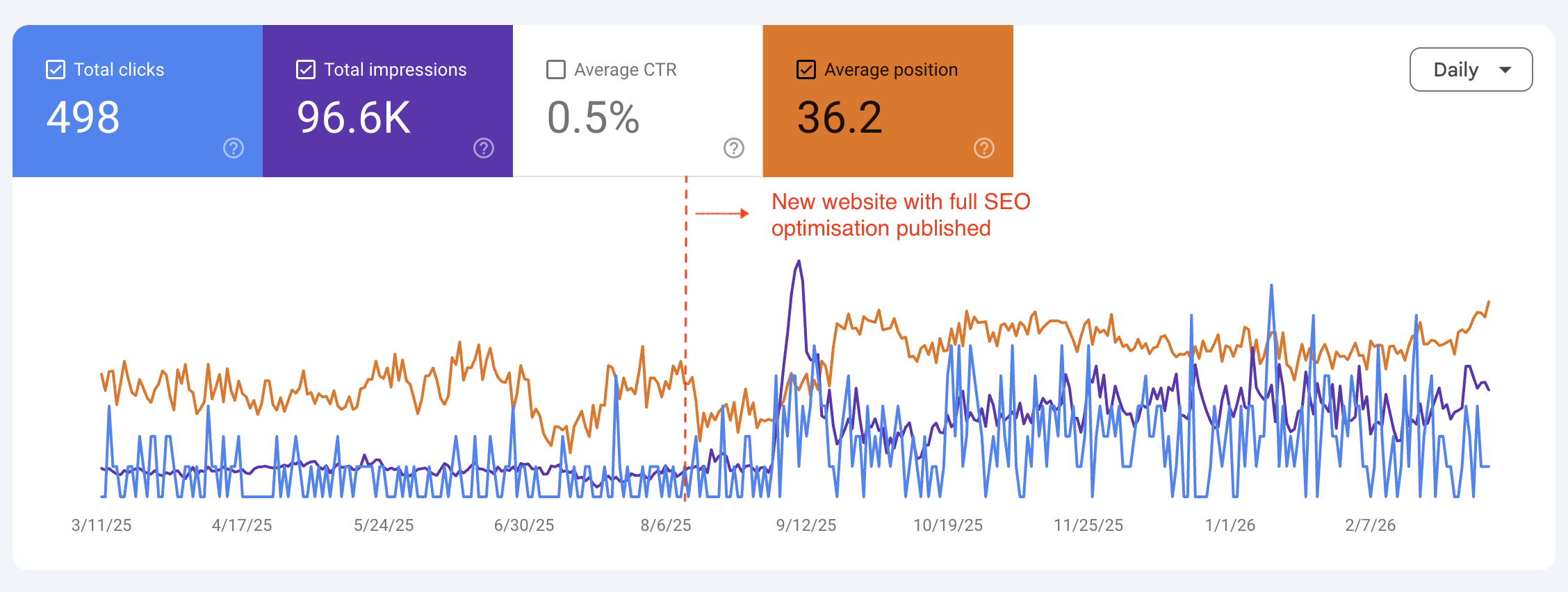
Results from a Full SEO Makeover client: SEO performance for a wedding videographer based in the UK. You can clearly see the overall rank initially dropping while impressions significantly increase, followed by a rise in total clicks.
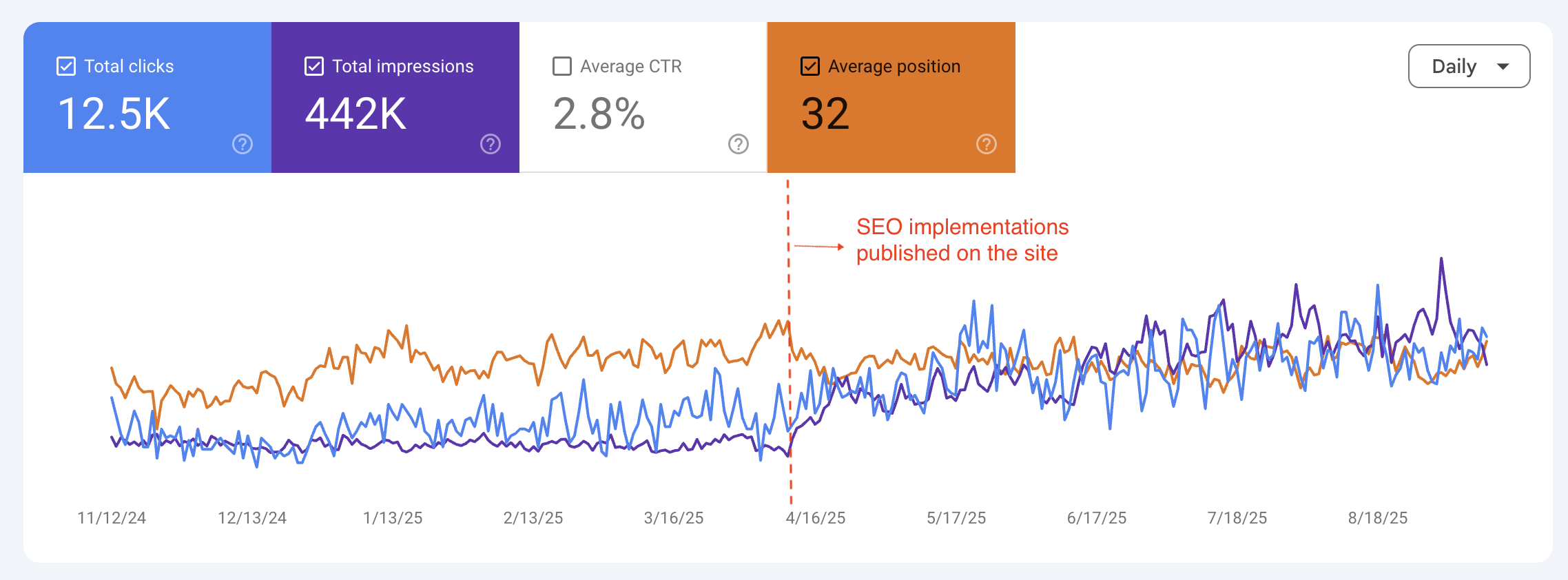
Results from a Full SEO Makeover client: SEO for performance for a wedding venue based in the US. A similar trend to the above. Since their niche is less competitive than wedding videography, the difference in results is even more visible over a shorter period of time.
What About Click-Through Rate (CTR)?
CTR is the percentage of people who see your website in search results and actually click on it. It’s influenced by your position (higher positions get more clicks), but also by how compelling your page title and meta description are
A low CTR can sometimes mean that even though you’re ranking, your title or description isn’t enticing enough for people to click. This is worth keeping an eye on once your impressions are consistently high, as improving your titles and descriptions can give your clicks a real boost without needing to improve your ranking at all.
Don’t Forget To Track Your Actual Enquiries
All of the above is about how your website is performing on search. But ultimately, the goal of SEO isn’t just to get more traffic. It’s to get more of the right people finding your business and reaching out.
One of the simplest and most effective things you can do is ask every enquiry where they found you. Add a field to your enquiry form, or ask on discovery calls.
Over time, if you start hearing ‘Google’ or ‘I found you on search’, or even ‘ChatGPT’ more frequently, that’s your SEO working in the most tangible way possible.
I always recommend adding it to the enquiry form rather than asking verbally, because you’ll get the most accurate and consistent data that way.
How Long Does It Take to See Results from SEO?
This is the question everyone asks, and the honest answer is: it depends. Your website’s history, how competitive your specific niche is, how authoritative your website is (this is based on the number of quality backlinks you have) and how much work has been done all play a part.
As a general guide:
First 4 to 8 weeks: Look for impressions rising and the number of keywords you’re ranking for increasing. This is your earliest indicator.
Months 2 to 4: Individual keyword positions should start improving. Your overall average position may still be a bit all over the place, but specific keywords should be showing upward movement.
Months 4 to 6 and beyond: Clicks should start to rise more consistently as more keywords reach page one. This is when you’ll start to see the real business impact.
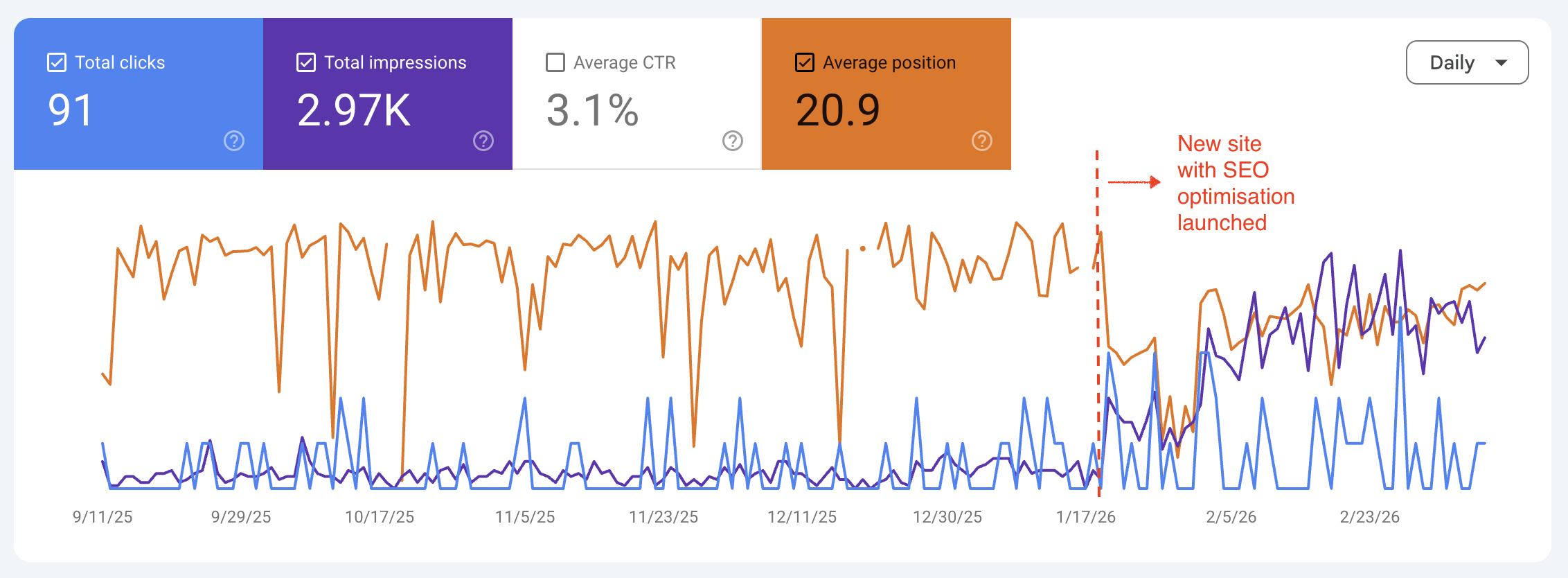
Results from a Bespoke SEO Strategy & Coaching Client: SEO performance for a wedding planner based in the US, after just 3 months. You can see how the average rank initially dropped significantly while impressions increased. Since this is only 3 months in, clicks haven’t yet caught up with impressions, but you can still see an upward trend there too.
It will probably take longer if your website is brand new or your domain authority is quite low.
SEO is a slow build, and that’s actually what makes it so powerful. Unlike paid ads that stop the moment you stop paying, SEO builds on itself over time. The results you see at six months are just the beginning of what’s possible at twelve or twenty-four months.
Celebrate the small wins along the way. A new keyword ranking, an uptick in impressions, a week with more clicks than the week before. These are all signs that your SEO is working, even before the big results arrive.
Not Sure If Your SEO Is Actually Working for Your Business?
If you’ve been working on your SEO but you’re not seeing the signs above, or you’re looking at Search Console data and genuinely not sure what it’s telling you, I invite you to check out my SEO Clarity Audit & Action Plan.
I’ll personally review your website SEO, Google Business Profile, Pinterest and Instagram discoverability, and give you a recorded walkthrough of exactly what’s working, what isn’t, and what to prioritise next. No generic reports, no overwhelming technical jargon. Just a clear, specific direction for your business.
If your online presence isn’t bringing the enquiries you expected, let’s find out why and fix it.